If you’ve ever worked with industrial components—whether it’s a pump seal in a chemical plant, a cutting tool in a manufacturing line, or a bearing in heavy machinery—chances are you’ve interacted with industrial ceramics, even if you didn’t realize it. As someone who’s spent 12 years supplying these materials to factories and engineering teams across North America, I can’t tell you how many times a client has called me, frustrated because a steel part wore out too fast in a harsh environment, and asked, “Why would ceramic work here?” The first question I always address is this: what exactly does “hardness” even mean when we’re talking about industrial ceramics, and how does that measure up to the stuff we usually reach for, like steel or aluminum? Most people think hardness is just how scratch-resistant something is, but in industrial settings, it’s way more nuanced than that. Industry Ceramics

Let’s start with the basics, because this is where a lot of beginners get tripped up. In materials science, hardness is defined as a material’s resistance to permanent deformation, indentation, or scratching—right? But when it comes to industrial applications, that definition doesn’t cut it on its own. A part that’s hard on a lab test might shatter if it’s hit with a sudden impact, or wear out fast if it’s exposed to abrasive, high-speed particles. So when we talk about the hardness of industrial ceramics, we’re not just quoting a number from a chart; we’re talking about how that hardness performs under real-world stressors.
Most folks who ask me this are referencing Vickers or Knoop hardness numbers, the standard metrics used in materials testing. For context, mild steel clocks in at around 120–200 Vickers. Tool steel, the hard stuff we use for drill bits and heavy machinery parts, can get up to 700 Vickers. Now, let’s talk about alumina, the most common industrial ceramic we supply. High-purity alumina—99.5% Al₂O₃—has a Vickers hardness of about 1,800. That’s nearly three times harder than tool steel. But wait, that’s just alumina. Silicon carbide, another workhorse ceramic for high-wear environments, hits 2,500 Vickers. And if we’re dealing with ultra-high-performance applications, like semiconductor manufacturing or extreme heat environments, silicon nitride can hit 2,200 Vickers, or even boron carbide, which clocks in at a staggering 3,000 Vickers. That’s almost five times harder than tool steel. But here’s the catch: those numbers are from lab tests, measured under controlled, low-load conditions. In a real industrial job, that hardness only translates to performance if the ceramic is engineered correctly.
I remember a client a few years back who came to us for valve seats for a slurry pipeline. They’d been using tool steel, which would last about three months before it wore down so much that the valve leaked. They ordered a standard 95% alumina ceramic from another supplier, installed it, and called me six weeks later complaining that it had already cracked and failed. When I went out to their plant to look at the part, I saw the issue immediately: the ceramic was hard, but it was too brittle to handle the sudden pressure spikes from the slurry flow. Their initial supplier had given them a low-grade alumina that wasn’t sintered properly, so it had tiny micro-cracks that turned into full breaks under stress. That’s the thing about industrial ceramic hardness—it’s not just about how hard it is, but how the material’s microstructure, purity, and manufacturing process shape that hardness. A porous, low-purity ceramic might score well on a Vickers test if you only measure a dense grain, but the overall part will be far less hard and durable than a fully sintered, high-purity version.
Let’s dive into the microstructure stuff, because that’s where the rubber meets the road (pun intended, since we also supply ceramic liners for conveyor belts). Industrial ceramics are made by sintering fine powder at high temperatures, usually under pressure to get that tight, dense grain structure. For alumina, if you sinter it at too low a temperature, you end up with pores between the alumina grains. Those pores don’t contribute to hardness—if anything, they create weak points that can be crushed or scratched through easily. High-purity alumina, sintered at over 1,600°C, has grains that lock together tightly, so that Vickers hardness number translates to actual scratch resistance and wear resistance. Compare that to a 90% alumina, which has more glassy phase (impurities like silica) between grains. That glassy phase is softer, so the overall hardness is lower, and it can wear away faster when exposed to corrosive chemicals or abrasive particles.
Another point people miss when comparing ceramic hardness to metal hardness is how it handles different types of wear. Steel is tough, so it can bend or dent before breaking, but it’s relatively soft when it comes to scratching. Ceramics, on the other hand, are hard, so they don’t scratch or indent easily, but they can be brittle if their hardness isn’t matched to the load. Let’s say you have two surfaces rubbing together: if one is a hard ceramic and the other is a softer metal, the metal will wear away faster, because the ceramic doesn’t deform. But if you have two hard surfaces (like ceramic on ceramic) and you introduce a hard abrasive, like sand or silicon carbide particles, the abrasive will scratch into both surfaces. Here’s where ceramic hardness really shines: the harder the ceramic, the less the abrasive can cut into it. So in that slurry pipeline I mentioned earlier, the right ceramic—high-purity alumina with a modified grain structure to boost toughness—wouldn’t just be hard enough to resist abrasion; it would also handle the pressure spikes without cracking. We eventually worked with that client to adjust the valve seat design, using a 99.7% alumina with a small amount of zirconia added to improve fracture toughness. That part has lasted four years now, and they haven’t looked back.
I get a lot of questions too about how hardness holds up at high temperatures, because that’s a huge factor in industrial settings. A lot of metals soften as they heat up—tool steel starts to lose its hardness above 500°C, for example. Industrial ceramics? Their hardness actually holds up way better at elevated temperatures. High-purity alumina keeps 80% of its room-temperature hardness at 1,000°C, and silicon carbide retains most of its hardness even at 1,600°C. That’s why we supply silicon carbide crucibles for metal casting operations, where the crucible has to withstand molten metal at 1,200°C or higher. A steel crucible would warp and lose shape, but a silicon carbide one stays hard and stable, so the cast parts come out with consistent dimensions.
Of course, no material is perfect, and industrial ceramics’ hardness has tradeoffs. That’s why it’s never a one-size-fits-all solution. For a low-stress application, like a guide roller in a packaging line, a lower-grade alumina is more than enough, and it’s cheaper. But for a high-wear, high-stress application, like a cutting blade for recycled glass, you need silicon carbide, because its extra hardness resists scratching from glass shards, and its modified microstructure gives it enough toughness to not chip when it hits a thick piece of glass. I’ve seen clients try to use boron carbide in applications where it’s overkill—yes, it’s super hard, but it’s also more expensive and more brittle, so it’s not worth the cost when a cheaper alumina would do the job just fine. A lot of my job as a supplier isn’t just selling ceramic parts; it’s helping clients pick the right hardness level for their specific application, so they get the best performance without overspending.
Let’s talk about a common misconception I hear all the time: people think “harder equals better.” But that’s not always true. I had a client in the food processing industry a few years back who wanted to use boron carbide for their pump components, because it’s the hardest thing around. Turns out, boron carbide is very hard, but it’s also very abrasive—wait, no, wait, not on the food, but on the mating parts. The client had designed their pump with stainless steel shafts, and the boron carbide ceramic was so hard that it was wearing down the stainless steel shafts, not the other way around. They ended up switching to 99.5% alumina, which is still way harder than steel, but not so hard that it wears down the mating components. That’s a perfect example of how understanding hardness isn’t just about the ceramic itself—it’s about how it interacts with every other part of the system.
Another real-world example: we recently supplied ceramic liners to a coal-fired power plant for their ash handling systems. Ash is incredibly abrasive—tiny, sharp silica particles that move at high speed through pipes and chutes. The plant had been using manganese steel liners, which lasted about two years before they were worn through. We supplied silicon carbide liners, which have a Vickers hardness of 2,500, and those liners have now lasted six years with minimal wear. That’s a huge cost savings for them, because they don’t have to shut down the plant every two years to replace liners, which costs millions in downtime alone. The hardness of the silicon carbide is the key here—it resists scratching and erosion from the ash particles, so the liners last way longer than steel.
Now, if you’re someone who’s not deep in materials science, all these numbers might feel overwhelming, but that’s why I always tell potential clients to reach out. You don’t have to memorize Vickers hardness ratings or sintering temperatures to figure out what kind of ceramic you need. The question of “what’s the hardness of industrial ceramics?” is one that needs to be answered in context. It’s not just a number on a spec sheet; it’s a property that’s tailored to withstand the specific conditions of your operation: the temperature, the abrasive materials, the pressure, the chemicals, even the mating parts you’re working with.
At the end of the day, industrial ceramics’ hardness is what makes them invaluable in so many industries that rely on durability and efficiency. From semiconductor manufacturing, where tiny, precise ceramic parts have to withstand high temperatures and corrosive chemicals, to mining, where ceramic liners stand up to constant impact and abrasion, to food and beverage processing, where ceramic parts are non-toxic and easy to clean. But the only way to get the right performance is to work with someone who understands that hardness is more than a test result—it’s a tool that needs to be matched to your needs.
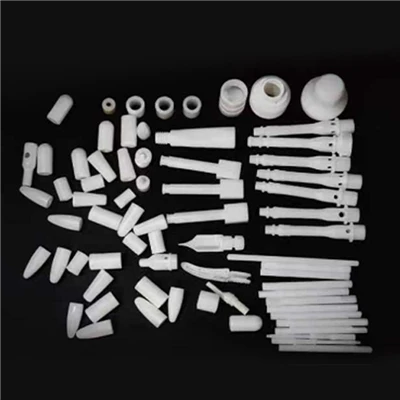
If you’re dealing with worn parts, high maintenance costs, or downtime that’s eating into your profits, I’d be happy to walk through your application with you. We don’t just supply off-the-shelf ceramic parts; we work with clients to engineer solutions that leverage the right ceramic hardness, microstructure, and material to solve their specific challenges. Whether you’re looking to replace steel parts, improve wear resistance, or handle extreme temperatures, we can help you figure out the best industrial ceramic for the job. Reach out to us to start a conversation about your needs—no pressure, just honest advice based on years of working with industrial ceramics across countless applications.
Ceramic Parts References:
- Ashby, M. F., & Jones, D. R. H. (2012). Engineering Materials 1: An Introduction to Properties, Applications, and Design. Butterworth-Heinemann.
- Lee, W. E., & Rainforth, W. M. (2014). Ceramic Materials: Science and Engineering. Springer.
- Fischer-Cripps, A. C. (2004). Nanoindentation. Springer.
- Quinn, G. D., & Quinn, J. B. (2010). Indentation Hardness Testing: Understanding and Using the ISO 14577 Standard. ASTM International.
Haining Yifeng Ceramic Technology Co., Ltd.
We are one of the most experienced industry ceramics manufacturers and suppliers in China, also support customized service. Welcome to buy high quality industry ceramics made in China here and get pricelist from our factory. For price consultation, contact us.
Address: No. 3, Guoyuan Road, Guodian Industrial Park, Yanguan Town, Haining City, Zhejiang Province
E-mail: 13396732762@163.com
WebSite: https://www.yifengcer.com/
